
Berlin
A control tower was erected at West Berlin's Joachimsthaler Platz to manage car traffic in 1956.
Discover Europe's rich industrial heritage with a journey through its historic sites. From towering steel mills to repurposed factories, explore the monuments to innovation and the legacy of the Industrial Revolution.
A control tower was erected at West Berlin's Joachimsthaler Platz to manage car traffic in 1956.

The Albert Canal was opened to shipping in 1939. However, its construction had consequences for rail traffic. Railway line 20's route between Hasselt and Maastricht was changed, and the Albert Canal at Gellik was crossed via a Vierendeel bridge.

Not much remains of Ramskapelle's former railway station today, as it was shot to pieces during the Battle of the Yser. The station was, therefore, right on the front line along the Yser.

Several metres of reconstructed tram tracks recall the world's first electric tram ride in the German capital, Berlin. Werner von Siemens stood at the cradle of that world first.

On the night of 18-19 January 1923, the Dutch East Indies (today's Indonesia) caught the first test signals from the Dutch broadcasting station Kootwijk, over 12,000 kilometres away. It was a miracle of technology—or was it?

No expense was spared in building the more than 46-kilometre-long railway line between the Dutch town of Lage Zwaluwe and Hertogenbosch. Thus, in the 1880s, the construction of a spacious railway bridge above the Bossche inundation field began.

Around a flooded quarry, you can still find traces of the exploitation of yesteryear, such as lime kilns, a rusted portal crane, brick tunnels and a loading quay to transport blocks of stone.

Of the six blast furnaces that the Uckange steel factory had in the early twentieth century, today, only the 71-meter-high blast furnace 4 remains.
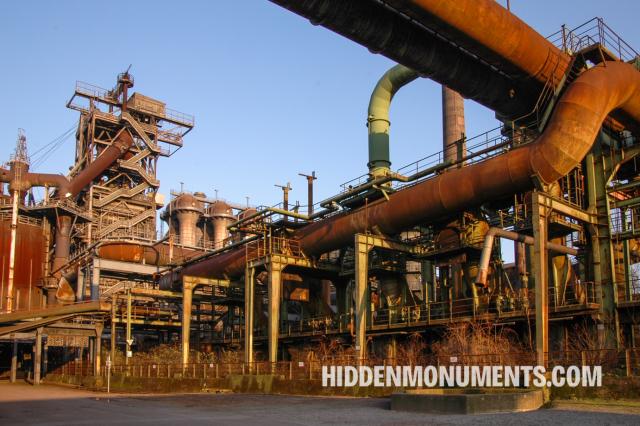
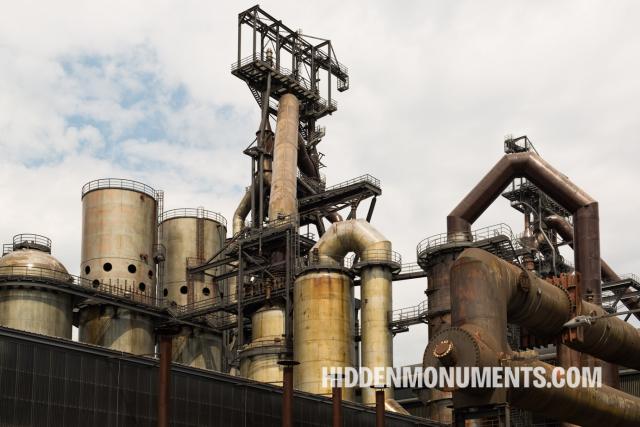
The Belval blast furnaces in Esch-sur-Alzette are the last remnants of the Grand Duchy of Luxembourg steel industry. In 1997, the steel factory was shut down for good, only to rise like a phoenix from its ashes a few years later.
Get the latest stories straight to your inbox
Latest from the blog

On the occasion of International Art Nouveau Day, celebrated each year on June 10, a look at how this ornate architectural movement found its way into the most unlikely of places like coal mines, power stations, and railway yards and the long, sometimes heartbreaking battles to save what remains.
All photos and stories are copyrighted. Of course, linking to articles on the site is possible and allowed.
If you would like to use photos or articles from this website, please contact bart@hiddenmonuments.com.
© 2003-2026 Hiddenmonuments.com