
Liège
In the early twentieth century, a tunnel more than 140 meters long was excavated right through the rock on which the castle ruins of the Counts of Dalhem rest to construct local tramway line 466 between Liège and 's-Gravenvelden.
Explore over 600 destinations previously published in the archive. Premium members unlock the full story for each destination, GPS coordinates, addresses, heritage maps, and tips for legal visits.
In the early twentieth century, a tunnel more than 140 meters long was excavated right through the rock on which the castle ruins of the Counts of Dalhem rest to construct local tramway line 466 between Liège and 's-Gravenvelden.

Anhalter Bahnhof has been wiped off the map, except for the facade. However, in 1880, it was the largest station in Europe.


The Bijgaardehof, the former place where monks of St. Bavo's Abbey grew bees during the Middle Ages, was buried under the buildings of the Baertsoen-Buysse spinning mill at the end of the nineteenth century.

The Behrensbau is the crown jewel of Berlin's Oberschöneweide industrial area. In 1917, architect and AEG designer Peter Behrens established the Nationale Automobil Gesellschaft (NAG) automobile factory there, a subsidiary of AEG.

The Borinage must once have had the densest railway network in the world, and that was due to the large concentration of coal mines in the region.

European heritage organization Europa Nostra has added the ruins of Charles of Lorraine's Palace in Mariemont to its shortlist of most endangered monuments in 2023.

Of the forty-five historic railway bridges built in 1870, twenty-nine still span Berlin's Yorckstraße today.
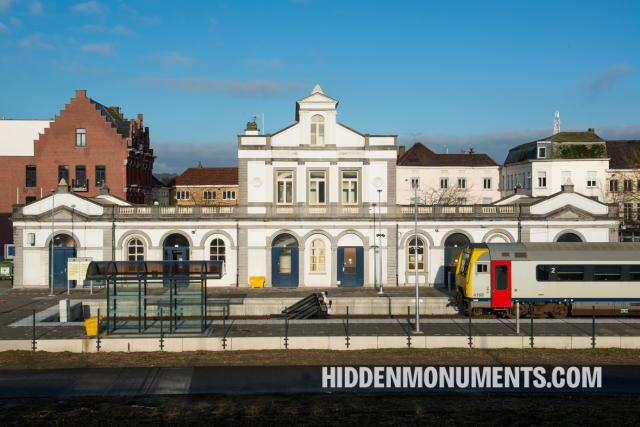
The Belgian Ronse station is today the terminus for trains from Ghent, but until the mid-twentieth century, it was a junction of four different railway lines.

Get the latest stories straight to your inbox
Latest from the blog

On the occasion of International Art Nouveau Day, celebrated each year on June 10, a look at how this ornate architectural movement found its way into the most unlikely of places like coal mines, power stations, and railway yards and the long, sometimes heartbreaking battles to save what remains.
All photos and stories are copyrighted. Of course, linking to articles on the site is possible and allowed.
If you would like to use photos or articles from this website, please contact bart@hiddenmonuments.com.
© 2003-2026 Hiddenmonuments.com